
 Image 1 of 4
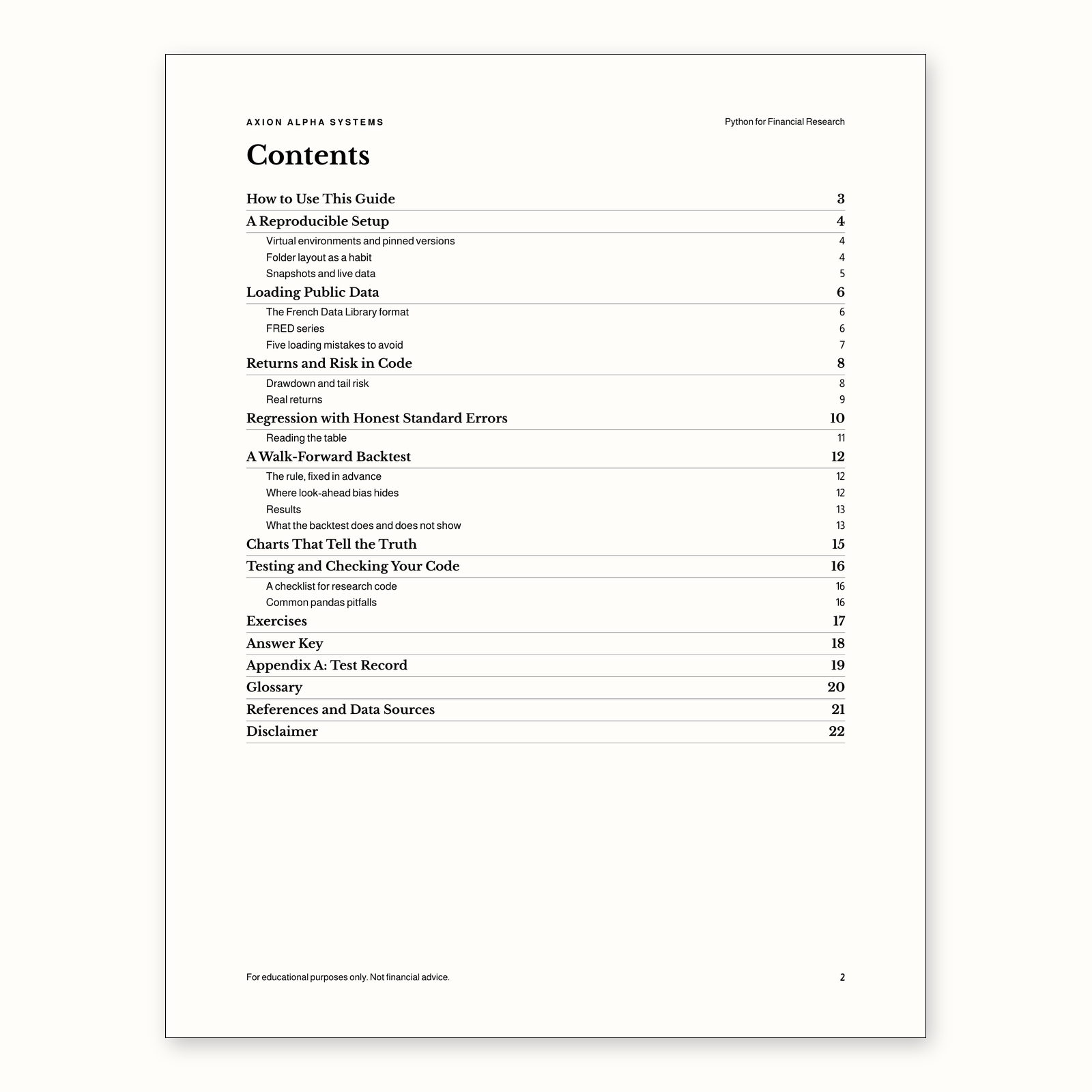 Image 2 of 4
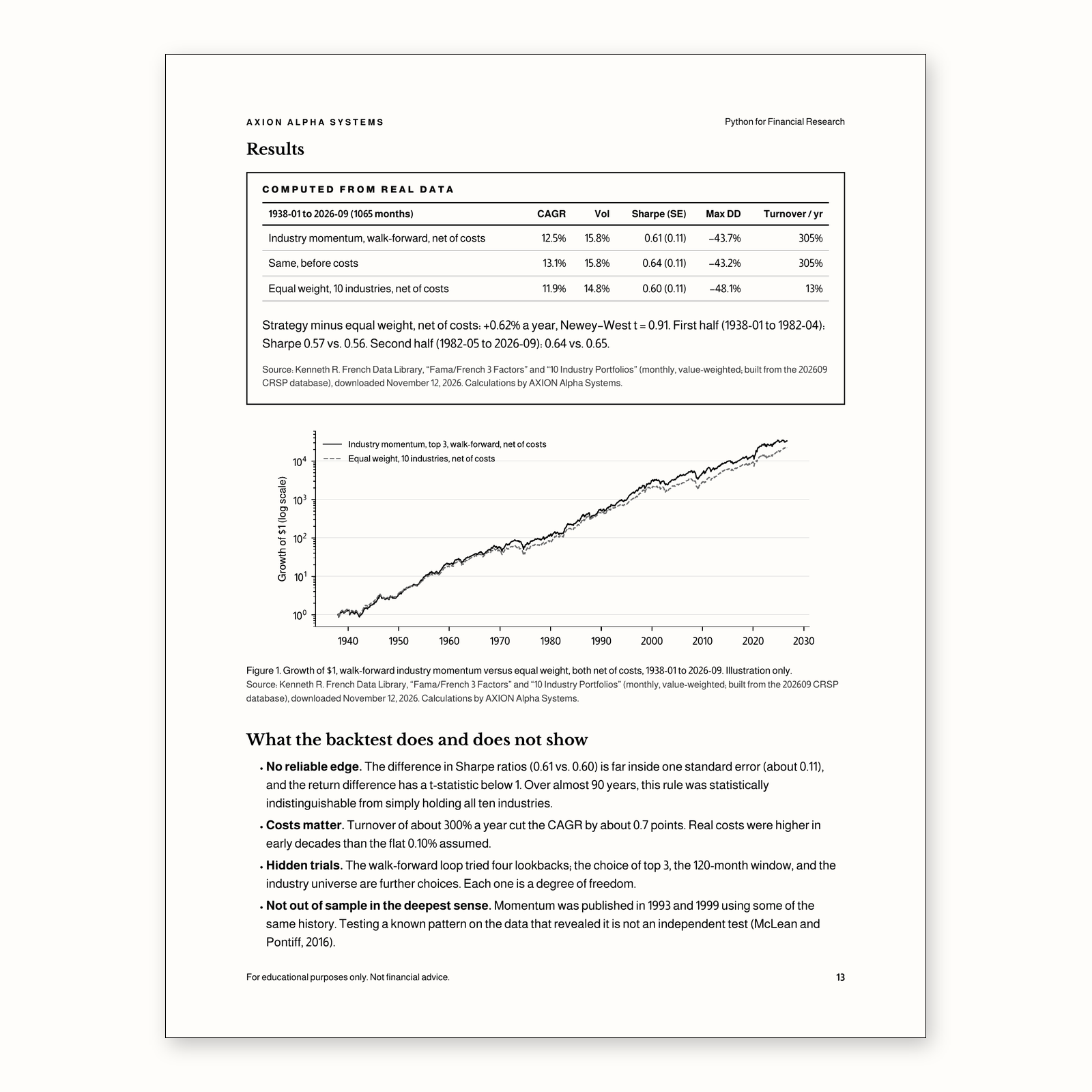 Image 3 of 4
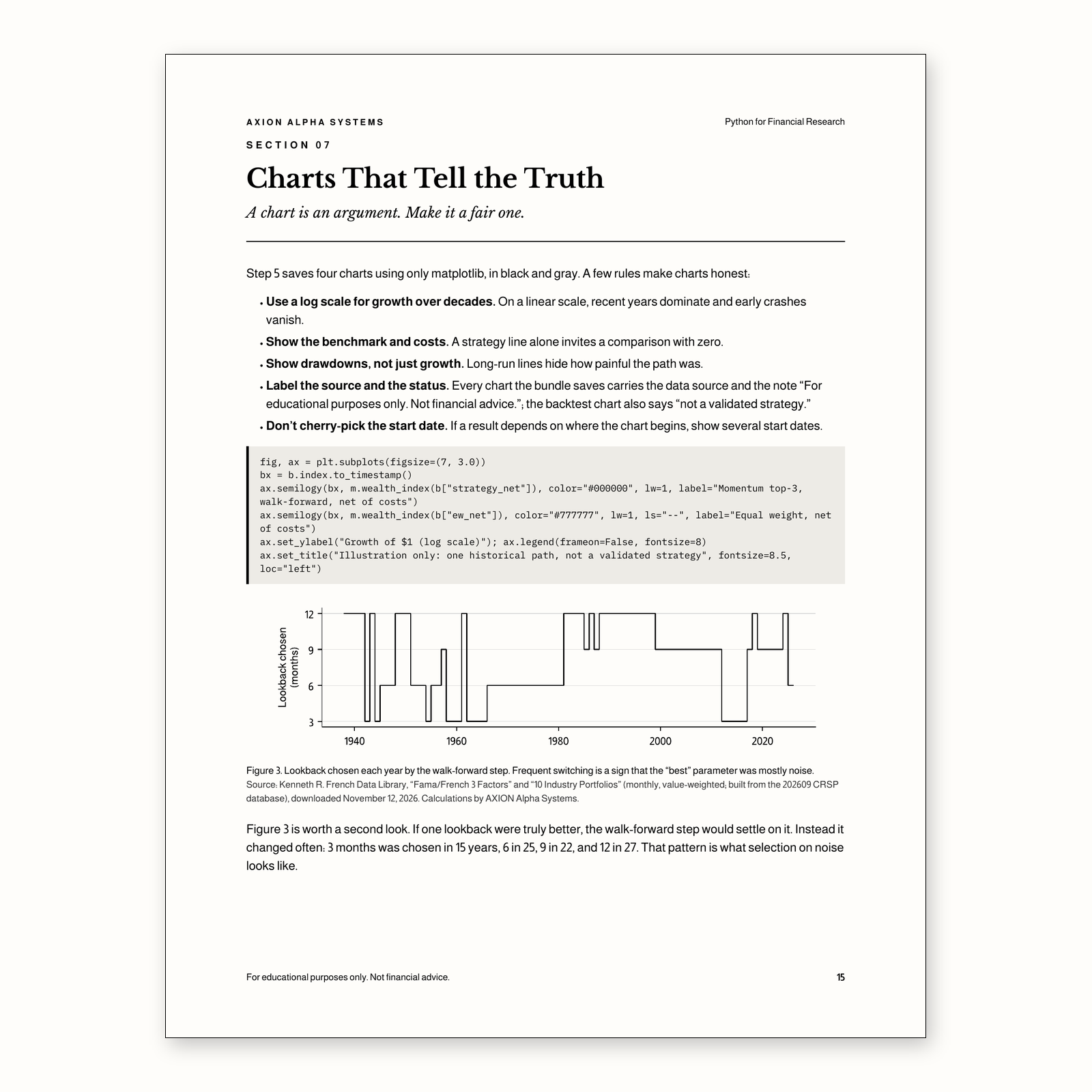 Image 4 of 4
A 22-page PDF guide plus a tested Python code bundle. Load real public data from the Ken French Data Library and FRED, compute returns and risk, run regressions with honest standard errors, build a walk-forward backtest that avoids look-ahead bias, and make charts that tell the truth. Data snapshots are included so it runs offline.
A reproducible setup: virtual environments, pinned package versions, and a folder layout you can reuse
Loading the Ken French Data Library and FRED in pandas, with five loading mistakes to avoid
Returns, volatility, Sharpe ratio, drawdown, VaR/CVaR, and inflation-adjusted returns in code
CAPM and Fama–French three-factor regressions with Newey–West standard errors, and how to read the output
A walk-forward industry-momentum backtest with costs and turnover, and the honest result: no statistically meaningful edge over equal weight (Newey–West t = 0.91)
A deliberate look-ahead bug that inflates the Sharpe ratio from 0.61 to 1.86, so you can see what the bias looks like
Charts, unit tests, a research-code checklist, and common pandas pitfalls
8 exercises with an answer key, a glossary, and references
Code bundle: 5 commented scripts, a small helper package, unit tests, a pinned requirements.txt, data snapshots, and a README with Mac and Windows setup
Students, analysts, and self-directed learners who know basic Python and want to do investment research with real data, reproducibly and without fooling themselves. Familiarity with returns and volatility helps; AXION’s Quantitative Finance Foundations covers the concepts.
ZIP download containing the PDF guide (22 pages, US Letter) and the code bundle. Requires Python 3.12 or later. Tested November 13, 2026 in a fresh virtual environment with Python 3.13.5 on Linux, offline and with live downloads; the README covers Mac and Windows setup.
It is not investment advice and does not provide a trading strategy. The backtest is a teaching example; it showed no statistically meaningful edge and is not presented as validated. The code is educational and not production trading software.
What Python do I need?
Python 3.12 or later. Pinned package versions are in requirements.txt; the README walks through setup on Mac and Windows.
Where does the data come from?
The Kenneth R. French Data Library (Fama–French factors and 10 industry portfolios) and FRED (GS10, TB3MS, CPIAUCSL, USREC), downloaded November 2026. Snapshots are included; an optional --live flag downloads fresh copies.
Will the code work on my computer?
It was tested end to end on Linux with Python 3.13.5. It uses only cross-platform paths and standard packages, but Mac and Windows were not tested directly.
Is this investment advice?
No. It is for educational purposes only.
For educational purposes only. Not financial advice. This product does not recommend any security, fund, or strategy, and nothing in it is a promise of future returns. Historical figures describe the past only.
A 22-page PDF guide plus a tested Python code bundle. Load real public data from the Ken French Data Library and FRED, compute returns and risk, run regressions with honest standard errors, build a walk-forward backtest that avoids look-ahead bias, and make charts that tell the truth. Data snapshots are included so it runs offline.
A reproducible setup: virtual environments, pinned package versions, and a folder layout you can reuse
Loading the Ken French Data Library and FRED in pandas, with five loading mistakes to avoid
Returns, volatility, Sharpe ratio, drawdown, VaR/CVaR, and inflation-adjusted returns in code
CAPM and Fama–French three-factor regressions with Newey–West standard errors, and how to read the output
A walk-forward industry-momentum backtest with costs and turnover, and the honest result: no statistically meaningful edge over equal weight (Newey–West t = 0.91)
A deliberate look-ahead bug that inflates the Sharpe ratio from 0.61 to 1.86, so you can see what the bias looks like
Charts, unit tests, a research-code checklist, and common pandas pitfalls
8 exercises with an answer key, a glossary, and references
Code bundle: 5 commented scripts, a small helper package, unit tests, a pinned requirements.txt, data snapshots, and a README with Mac and Windows setup
Students, analysts, and self-directed learners who know basic Python and want to do investment research with real data, reproducibly and without fooling themselves. Familiarity with returns and volatility helps; AXION’s Quantitative Finance Foundations covers the concepts.
ZIP download containing the PDF guide (22 pages, US Letter) and the code bundle. Requires Python 3.12 or later. Tested November 13, 2026 in a fresh virtual environment with Python 3.13.5 on Linux, offline and with live downloads; the README covers Mac and Windows setup.
It is not investment advice and does not provide a trading strategy. The backtest is a teaching example; it showed no statistically meaningful edge and is not presented as validated. The code is educational and not production trading software.
What Python do I need?
Python 3.12 or later. Pinned package versions are in requirements.txt; the README walks through setup on Mac and Windows.
Where does the data come from?
The Kenneth R. French Data Library (Fama–French factors and 10 industry portfolios) and FRED (GS10, TB3MS, CPIAUCSL, USREC), downloaded November 2026. Snapshots are included; an optional --live flag downloads fresh copies.
Will the code work on my computer?
It was tested end to end on Linux with Python 3.13.5. It uses only cross-platform paths and standard packages, but Mac and Windows were not tested directly.
Is this investment advice?
No. It is for educational purposes only.
For educational purposes only. Not financial advice. This product does not recommend any security, fund, or strategy, and nothing in it is a promise of future returns. Historical figures describe the past only.