
 Image 1 of 5
 Image 2 of 5
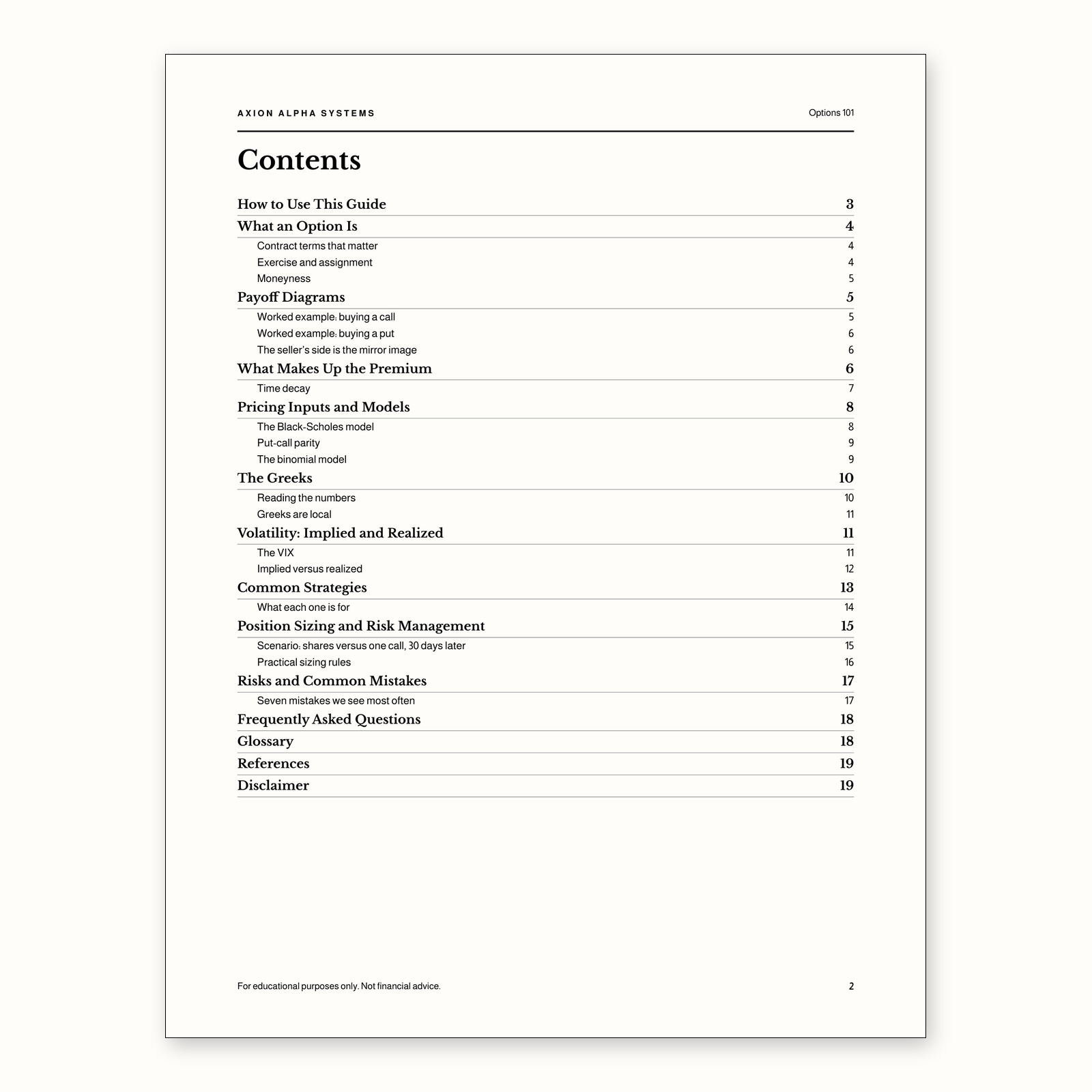 Image 3 of 5
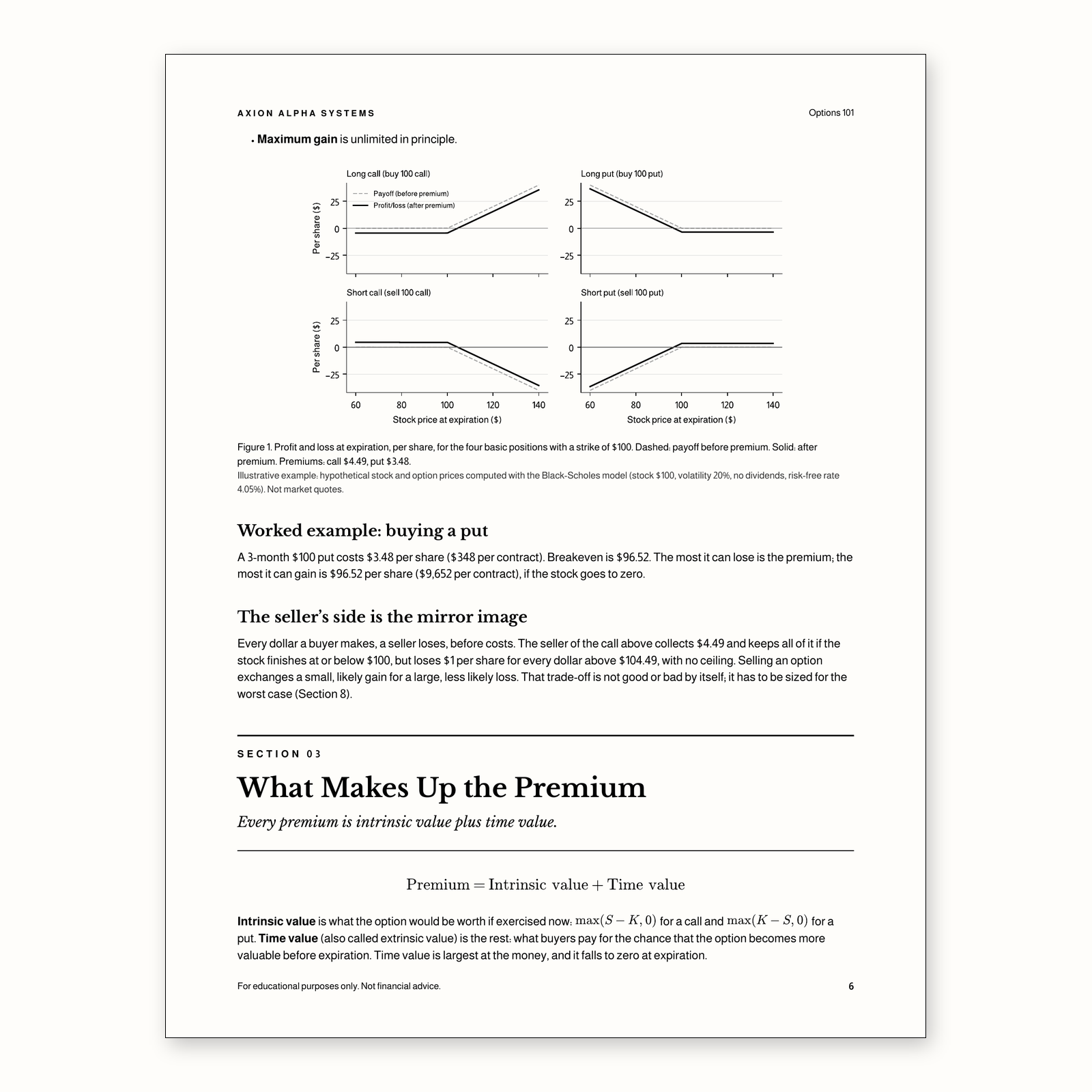 Image 4 of 5
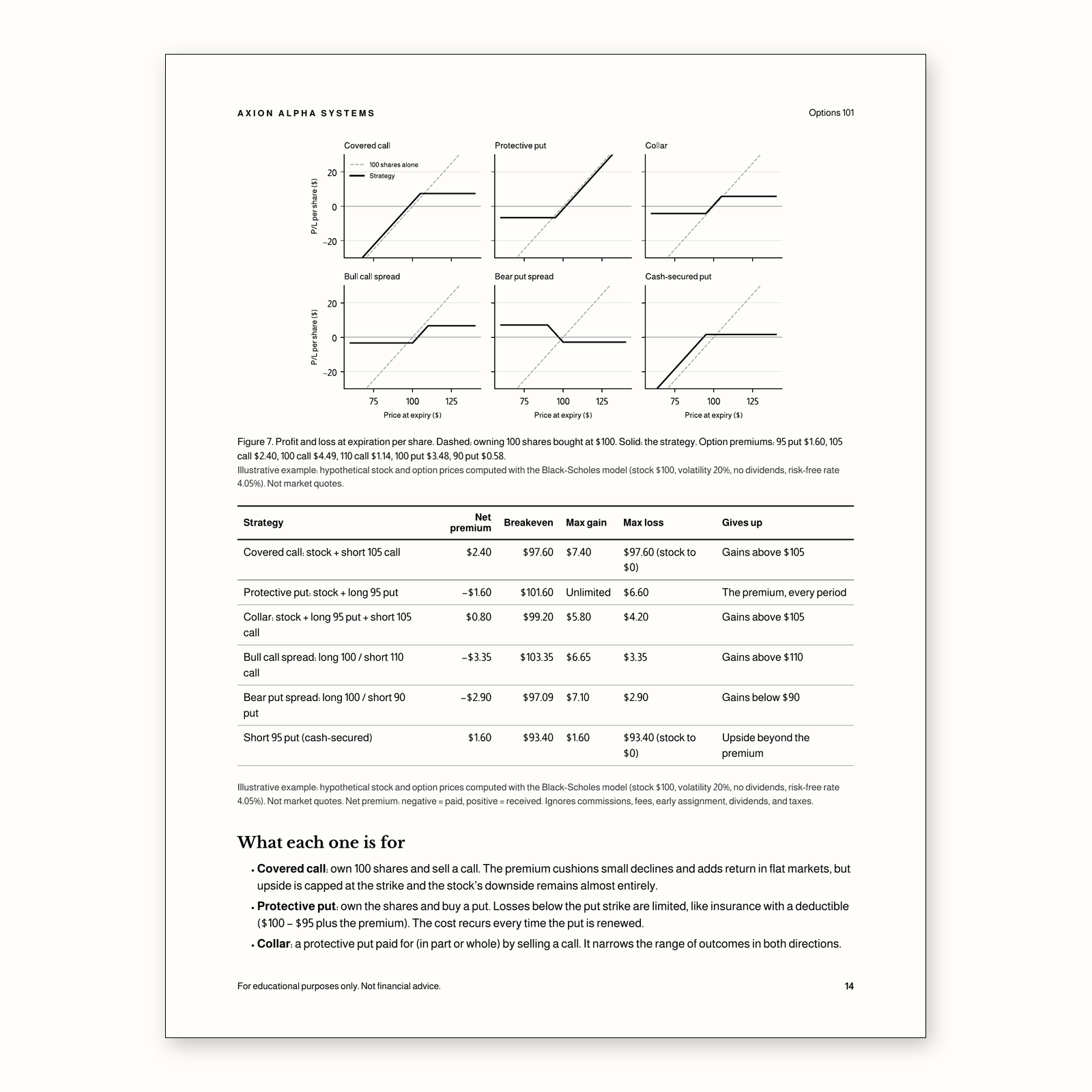 Image 5 of 5
A full-length, plain-language guide to listed stock options: what the contracts are, how to draw their payoffs, how premiums are priced, how to read the Greeks, what implied volatility is, and how to size positions so a loss is survivable. Every price is worked out in code and every chart is drawn from the stated inputs. The volatility section uses 36 years of real VIX data. 20 pages.
What's inside
What an option is: calls vs. puts, rights and obligations, the 100-share multiplier, American vs. European exercise, settlement, exercise and assignment, and moneyness
Payoff diagrams for long and short calls and puts, with worked tables for breakeven, maximum gain and maximum loss
The premium: intrinsic value plus time value by strike, and a time-decay chart from 90 days to expiration
Pricing: the five inputs, the Black-Scholes model with a step-by-step worked example, put-call parity checked to the cent, and a two-step binomial tree that converges to Black-Scholes and prices an American put
The Greeks (delta, gamma, theta, vega, rho) with values for the worked example, per-contract meaning, and delta and gamma charts
Volatility from real data: the VIX from 1990 to November 2026, and how often implied volatility exceeded the volatility that followed (FRED and Kenneth R. French Data Library data)
Six strategies with payoff charts and a comparison table: covered call, protective put, collar, bull call spread, bear put spread, and cash-secured put, plus a warning box on uncovered calls
Position sizing: cash at risk, notional, delta-equivalent shares and leverage, and a 30-day scenario comparing 100 shares with one call
Ten risks and seven common mistakes, a pre-trade checklist, an FAQ, a glossary, and references (Black-Scholes 1973, Merton 1973, Cox-Ross-Rubinstein 1979, OCC, FINRA, SEC, IRS)
Who it's for
Investors and finance students who already understand stocks and want a thorough, honest foundation in options before using them, or instead of using them.
Format
PDF, 20 pages, US Letter. Second edition, expanded (November 2026). Instant download. Nothing ships.
What it's not
It is not trading advice and does not recommend any trade, strategy, or security. All option prices are illustrative and computed from a model; they are not market quotes. Strategy examples show how each structure works, not what to do.
FAQ
How long is it?
20 pages: a title page, contents, an introduction, nine numbered sections, an FAQ, a glossary, references and a disclaimer. It replaces the earlier 5-page primer.
How much math do I need?
Arithmetic is enough to follow the guide. The Black-Scholes and binomial formulas are shown and every number is worked through, but you don't need to calculate them yourself to understand the ideas.
Are the numbers real?
The VIX and realized-volatility figures are computed from real public data, and the sources are named. The option prices and Greeks come from one hypothetical example (a $100 stock, 20% volatility, 3 months to expiration) and are labeled as illustrative.
Do I need a brokerage account to use this guide?
No. It is a reading guide on how options work, with no trading required.
Is there a free tool to go with it?
Yes. The free Options Trade Analyzer (/free/options-trade-analyzer) is an Excel workbook for breakeven, capital required, maximum loss, payoff at expiration, position sizing, and a trade journal.
Is this enough to start trading options?
It is a foundation, not a license to trade. Options involve substantial risk and are not suitable for all investors. As the guide says, read the Options Clearing Corporation's "Characteristics and Risks of Standardized Options" before trading, and consider a licensed professional.
Can I get a refund?
This is a digital download. If the file is corrupted or won't open, email us within 14 days for a replacement or refund. See the Refund Policy.
Disclaimer
For educational purposes only. Not financial advice. This material does not constitute financial, investment, or tax advice. Options involve substantial risk and are not suitable for all investors.
A full-length, plain-language guide to listed stock options: what the contracts are, how to draw their payoffs, how premiums are priced, how to read the Greeks, what implied volatility is, and how to size positions so a loss is survivable. Every price is worked out in code and every chart is drawn from the stated inputs. The volatility section uses 36 years of real VIX data. 20 pages.
What's inside
What an option is: calls vs. puts, rights and obligations, the 100-share multiplier, American vs. European exercise, settlement, exercise and assignment, and moneyness
Payoff diagrams for long and short calls and puts, with worked tables for breakeven, maximum gain and maximum loss
The premium: intrinsic value plus time value by strike, and a time-decay chart from 90 days to expiration
Pricing: the five inputs, the Black-Scholes model with a step-by-step worked example, put-call parity checked to the cent, and a two-step binomial tree that converges to Black-Scholes and prices an American put
The Greeks (delta, gamma, theta, vega, rho) with values for the worked example, per-contract meaning, and delta and gamma charts
Volatility from real data: the VIX from 1990 to November 2026, and how often implied volatility exceeded the volatility that followed (FRED and Kenneth R. French Data Library data)
Six strategies with payoff charts and a comparison table: covered call, protective put, collar, bull call spread, bear put spread, and cash-secured put, plus a warning box on uncovered calls
Position sizing: cash at risk, notional, delta-equivalent shares and leverage, and a 30-day scenario comparing 100 shares with one call
Ten risks and seven common mistakes, a pre-trade checklist, an FAQ, a glossary, and references (Black-Scholes 1973, Merton 1973, Cox-Ross-Rubinstein 1979, OCC, FINRA, SEC, IRS)
Who it's for
Investors and finance students who already understand stocks and want a thorough, honest foundation in options before using them, or instead of using them.
Format
PDF, 20 pages, US Letter. Second edition, expanded (November 2026). Instant download. Nothing ships.
What it's not
It is not trading advice and does not recommend any trade, strategy, or security. All option prices are illustrative and computed from a model; they are not market quotes. Strategy examples show how each structure works, not what to do.
FAQ
How long is it?
20 pages: a title page, contents, an introduction, nine numbered sections, an FAQ, a glossary, references and a disclaimer. It replaces the earlier 5-page primer.
How much math do I need?
Arithmetic is enough to follow the guide. The Black-Scholes and binomial formulas are shown and every number is worked through, but you don't need to calculate them yourself to understand the ideas.
Are the numbers real?
The VIX and realized-volatility figures are computed from real public data, and the sources are named. The option prices and Greeks come from one hypothetical example (a $100 stock, 20% volatility, 3 months to expiration) and are labeled as illustrative.
Do I need a brokerage account to use this guide?
No. It is a reading guide on how options work, with no trading required.
Is there a free tool to go with it?
Yes. The free Options Trade Analyzer (/free/options-trade-analyzer) is an Excel workbook for breakeven, capital required, maximum loss, payoff at expiration, position sizing, and a trade journal.
Is this enough to start trading options?
It is a foundation, not a license to trade. Options involve substantial risk and are not suitable for all investors. As the guide says, read the Options Clearing Corporation's "Characteristics and Risks of Standardized Options" before trading, and consider a licensed professional.
Can I get a refund?
This is a digital download. If the file is corrupted or won't open, email us within 14 days for a replacement or refund. See the Refund Policy.
Disclaimer
For educational purposes only. Not financial advice. This material does not constitute financial, investment, or tax advice. Options involve substantial risk and are not suitable for all investors.