A 20-page, beginner-friendly field guide to investing for individuals and small-business owners: protect, prioritize, invest, review. It shows how investment decisions differ when the money belongs to you rather than to a business. 2027 Reference Edition, built on SEC/Investor.gov, FINRA, IRS, SBA and TSP educational resources, with contribution limits updated to the 2027 IRS figures.
What's inside
The core idea: goal, time horizon, risk capacity vs. risk tolerance, and saving vs. investing
Personal foundation: the order to handle reserves, high-cost debt, employer match and insurance, plus a three-bucket (Now / Soon / Later) model
Accounts first: TSP/401(k), Traditional and Roth IRA, HSA and taxable brokerage, with 2027 reference limits ($25,500 elective deferral; $7,500 IRA; HSA $4,500 self-only / $9,000 family) and a military note on TSP and BRS matching
Know what you own: stocks, bonds, cash, real estate and alternatives, and how to read an ETF before buying it
Risk and diversification: six types of risk, and an illustrative conservative / balanced / growth allocation spectrum (examples, not recommendations)
Compounding and the Rule of 72, plus fees and taxes: expense ratios, advisory fees, trading costs and turnover
Business investing: operating cash, tax reserves, internal reinvestment, and a capital-allocation decision tree
Business tools: business cash, T-bills, brokerage, SEP-IRA, solo 401(k) and SIMPLE IRA (2027 figures: SEP up to $75,000, SIMPLE $17,500), and a sample investment policy and cash tiers
Avoidable mistakes and a fraud filter
A personal worksheet and a business worksheet (10 questions each), a 12-term glossary, and a 15-source reference desk (IRS, TSP, SEC/Investor.gov, FINRA, SBA)
Who it's for
New investors, service members, entrepreneurs, and small-business owners who want to understand why financial decisions are made, not just what to buy.
Format
PDF, 20 pages, US Letter. 2027 Reference Edition. Instant download. Nothing ships.
What it's not
It is not individualized investment, tax, legal, or accounting advice, and it does not recommend any security, fund, or account provider. The allocation examples are for teaching only, and contribution limits change; verify them on IRS.gov and tsp.gov.
FAQ
Is this for complete beginners?
Yes. It starts with what investing is and how it differs from saving, and it includes a plain-language glossary.
Does it cover business finances as well as personal?
Yes. Four sections cover business money: cash and tax reserves, a capital-allocation decision tree, small-business retirement plans (SEP-IRA, solo 401(k), SIMPLE IRA), and a business worksheet.
Are the contribution limits current?
Yes, for 2027. The guide uses the limits the IRS announced on Nov 12, 2026 (IR-2026-136 and Notice 2026-66): $25,500 for 401(k)/TSP deferrals, $7,500 for IRAs, $75,000 for SEP-IRAs, and $17,500 for SIMPLE IRAs. HSA limits ($4,500 self-only / $9,000 family) come from Rev. Proc. 2026-24. Limits change most years, so verify current numbers on IRS.gov and tsp.gov before acting.
I'm a service member. Is there something more specific?
The guide includes a military note on TSP and BRS. For more depth, see the free TSP, Roth & IRA Guide (/free/tsp-roth-ira-guide).
Can I get a refund?
This is a digital download. If the file is corrupted or won't open, email us within 14 days for a replacement or refund. See the Refund Policy.
Disclaimer
For educational purposes only. Not financial advice. This guide is not individualized investment, tax, legal, or accounting advice, and it does not recommend any security, fund, or strategy. Investment values can fall as well as rise. Nothing in it is a promise of future returns.

 Image 1 of 6
 Image 2 of 6
 Image 3 of 6
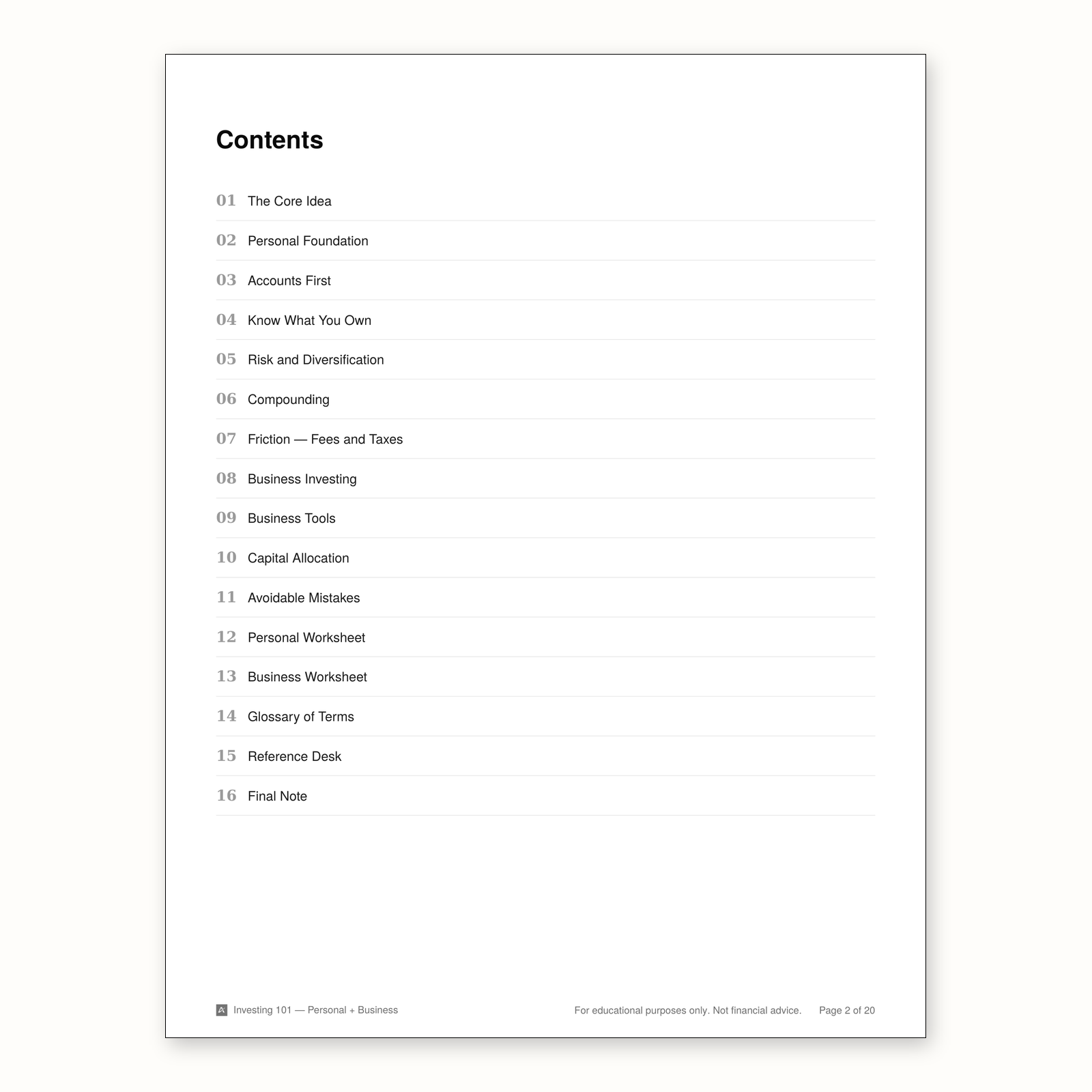 Image 4 of 6
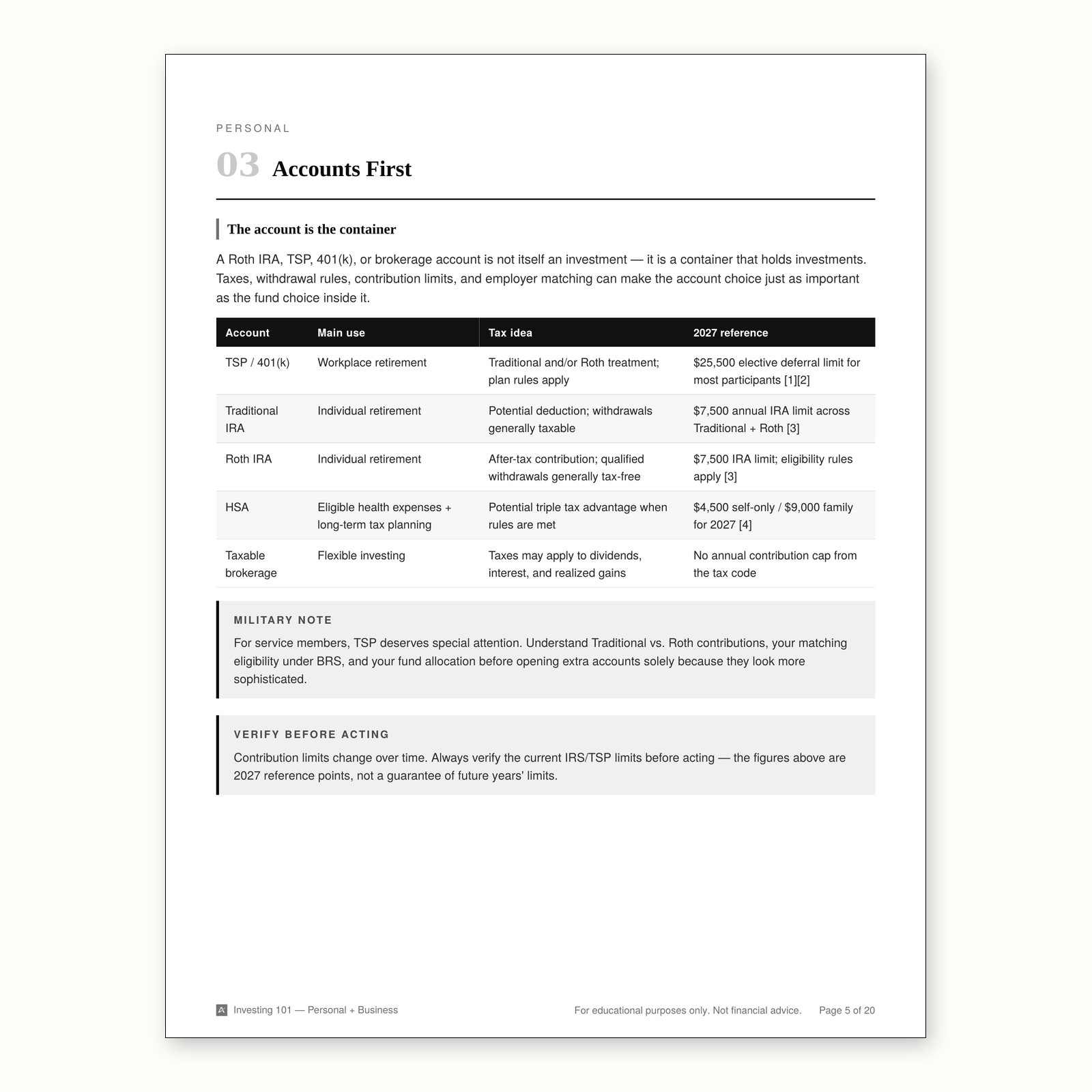 Image 5 of 6
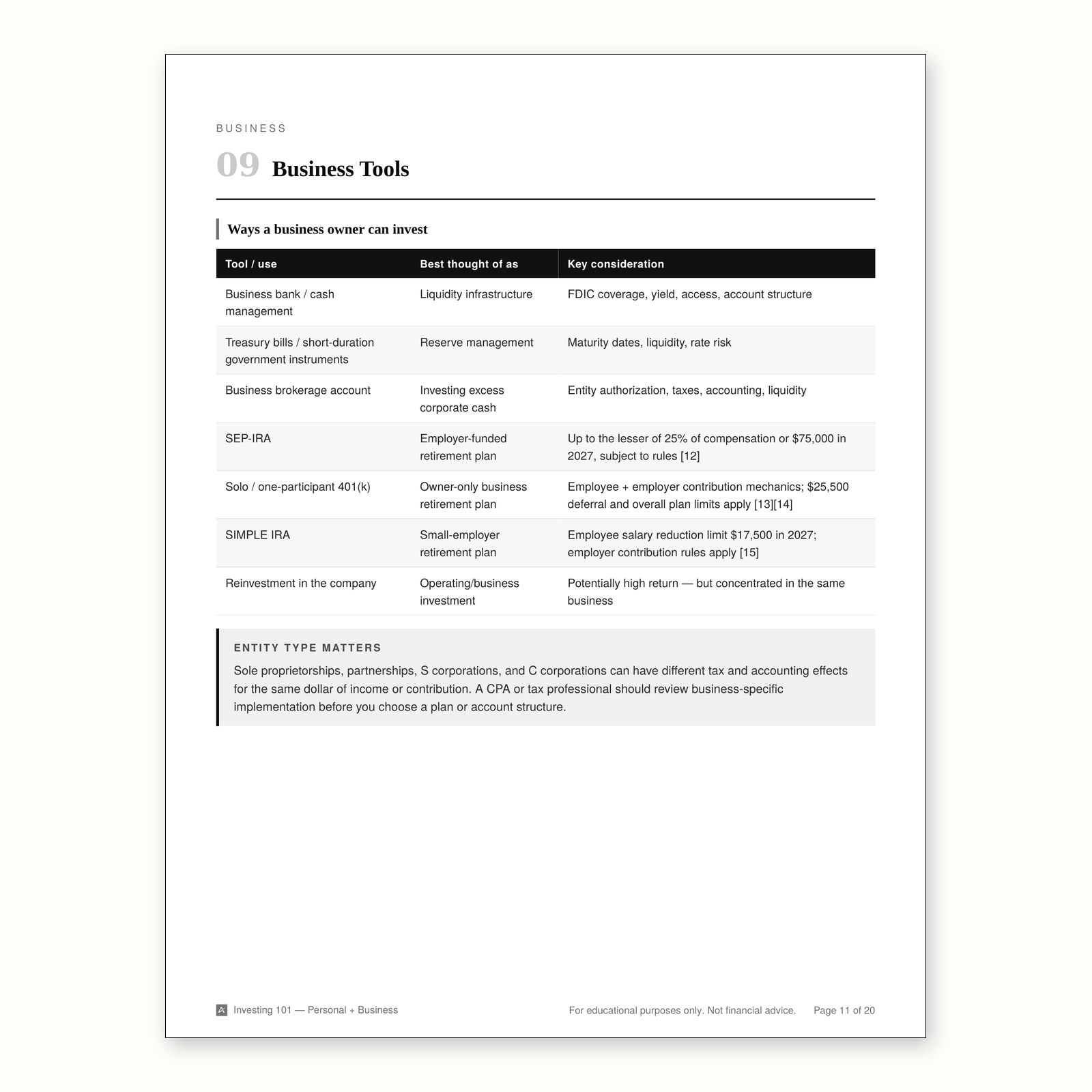 Image 6 of 6