
 Image 1 of 5
 Image 2 of 5
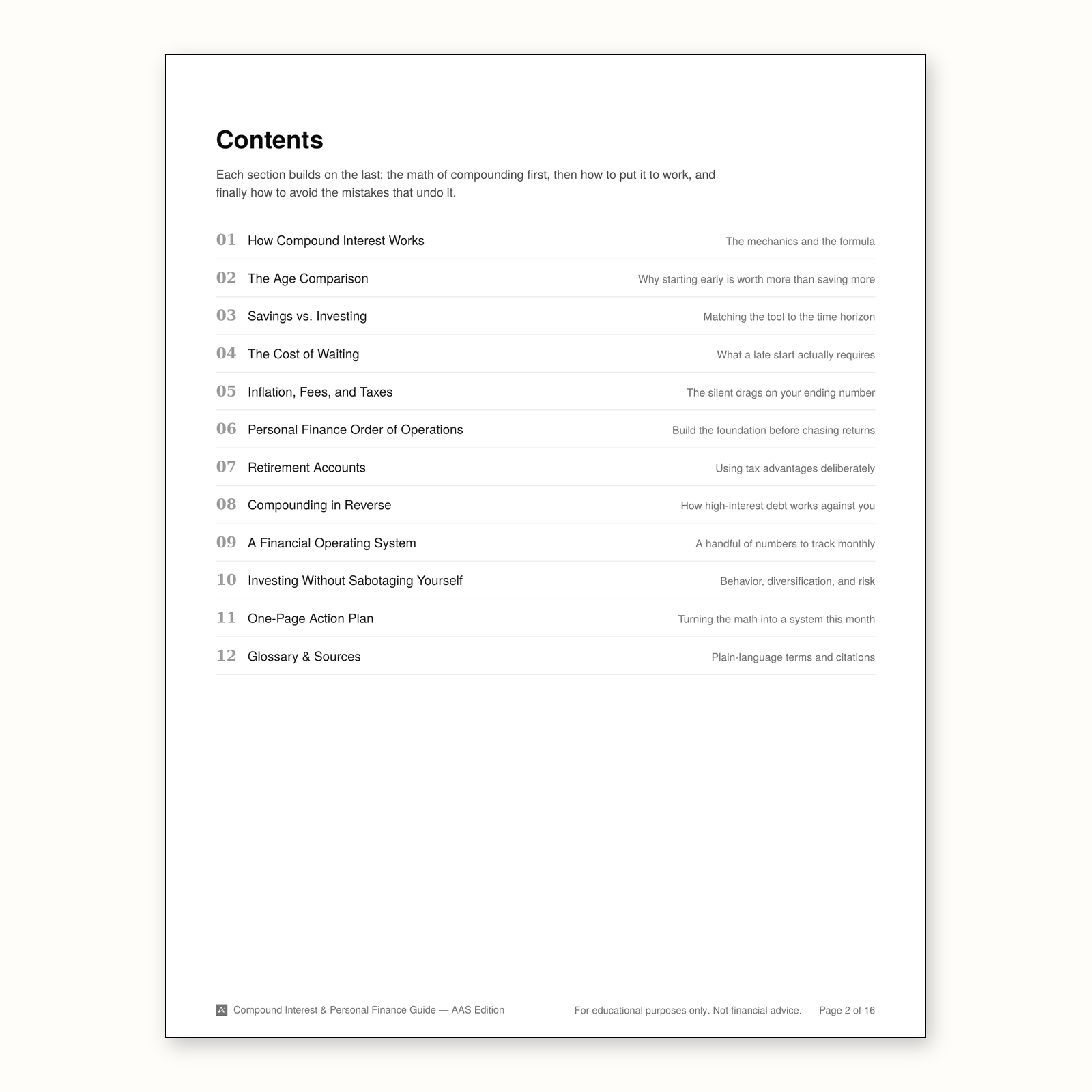 Image 3 of 5
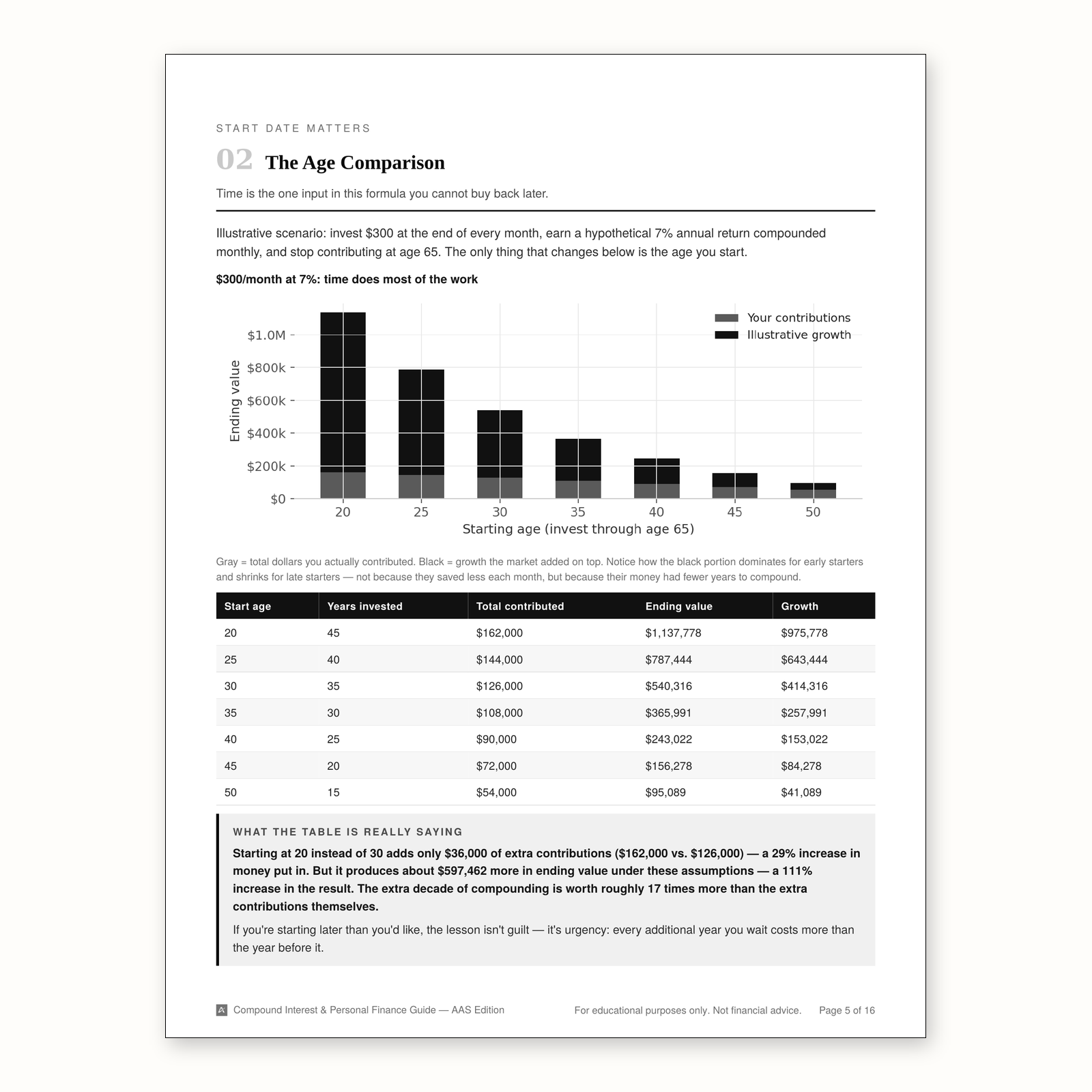 Image 4 of 5
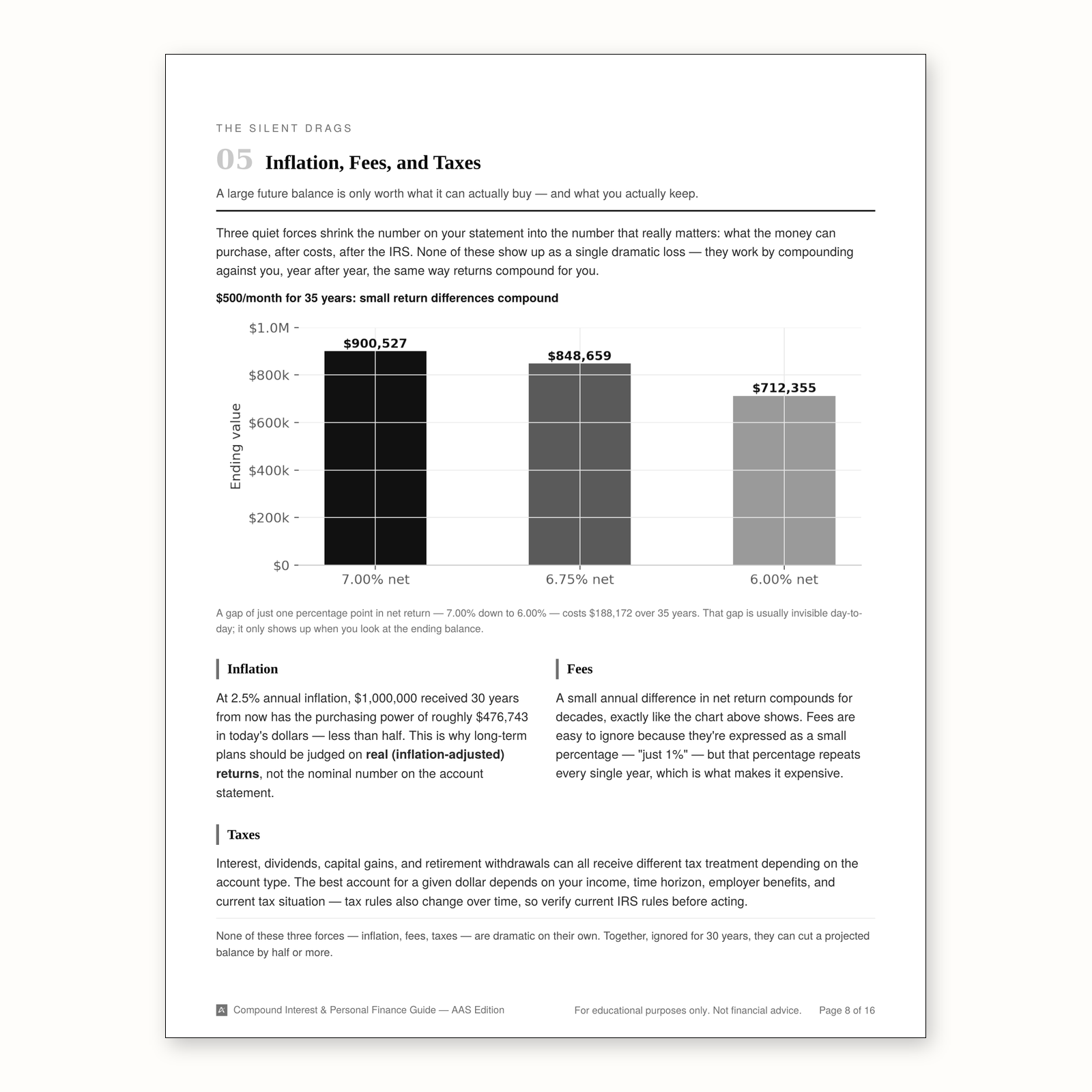 Image 5 of 5
A 16-page practical guide to how compounding works and how to put it to work: savings, investing, time, debt, retirement accounts, inflation, and fees, explained in plain language with the math shown. 2027 Reference Edition.
What's inside
How compound interest works: the formula in plain English, a worked example ($10,000 at 7% for 10 years), and the Rule of 72
The age comparison: $300 a month from age 20, 25, 30, 35, 40, 45 or 50 to age 65 at an illustrative 7%
Savings vs. investing: a 4% cash yield vs. a 7% investment return over 30 years, and how to match money to its time horizon
The cost of waiting: the monthly amount later starters would need to reach the same target
Inflation, fees and taxes: what a 1-point return gap costs over 35 years, and what $1,000,000 in 30 years buys in today's dollars
A personal-finance order of operations in 8 steps
Retirement accounts with 2027 limits (401(k)/403(b)/TSP $25,500; catch-ups $8,500 at 50+ and $11,750 at ages 60–63; IRA $7,500), and Traditional vs. Roth
Compounding in reverse: a 24% APR worked example, avalanche vs. snowball, and credit fundamentals
Six numbers to track monthly, behavior and diversification principles, and a fraud filter
A one-page action plan, a glossary, and 5 cited sources (SEC/Investor.gov, CFPB, IRS)
Who it's for
Anyone starting to build their finances, or anyone who wants a clear picture of how saving early, keeping fees low, and staying consistent add up over time.
Format
PDF, 16 pages, US Letter. 2027 Reference Edition. Instant download. Nothing ships.
What it's not
It is not personalized financial, investment, tax, or legal advice. Every growth figure uses labeled, hypothetical constant returns. These are illustrations, not forecasts or promised returns.
FAQ
How much math do I need?
Basic arithmetic. The compound-interest formula is shown, explained in plain English, and worked through step by step. The rest of the guide uses tables and charts.
Are the growth examples real returns?
No. They are illustrations that assume a constant hypothetical return (for example 7%, compounded monthly), and the assumptions are stated in the guide. Real returns vary and are not guaranteed.
Does it cover debt as well as saving?
Yes. A full section shows how high-interest debt compounds against you, with a worked 24% APR example and the avalanche and snowball payoff methods.
Is there a free tool to go with it?
The free Savings & Debt Toolkit (/free/savings-toolkit) tracks savings goals, an emergency fund, and debt payoff in one Excel workbook.
Can I get a refund?
This is a digital download. If the file is corrupted or won't open, email us within 14 days for a replacement or refund. See the Refund Policy.
Disclaimer
For educational purposes only. Not financial advice. This guide is not personalized financial, investment, tax, or legal advice. All examples are illustrative, and nothing in it is a promise of future returns.
A 16-page practical guide to how compounding works and how to put it to work: savings, investing, time, debt, retirement accounts, inflation, and fees, explained in plain language with the math shown. 2027 Reference Edition.
What's inside
How compound interest works: the formula in plain English, a worked example ($10,000 at 7% for 10 years), and the Rule of 72
The age comparison: $300 a month from age 20, 25, 30, 35, 40, 45 or 50 to age 65 at an illustrative 7%
Savings vs. investing: a 4% cash yield vs. a 7% investment return over 30 years, and how to match money to its time horizon
The cost of waiting: the monthly amount later starters would need to reach the same target
Inflation, fees and taxes: what a 1-point return gap costs over 35 years, and what $1,000,000 in 30 years buys in today's dollars
A personal-finance order of operations in 8 steps
Retirement accounts with 2027 limits (401(k)/403(b)/TSP $25,500; catch-ups $8,500 at 50+ and $11,750 at ages 60–63; IRA $7,500), and Traditional vs. Roth
Compounding in reverse: a 24% APR worked example, avalanche vs. snowball, and credit fundamentals
Six numbers to track monthly, behavior and diversification principles, and a fraud filter
A one-page action plan, a glossary, and 5 cited sources (SEC/Investor.gov, CFPB, IRS)
Who it's for
Anyone starting to build their finances, or anyone who wants a clear picture of how saving early, keeping fees low, and staying consistent add up over time.
Format
PDF, 16 pages, US Letter. 2027 Reference Edition. Instant download. Nothing ships.
What it's not
It is not personalized financial, investment, tax, or legal advice. Every growth figure uses labeled, hypothetical constant returns. These are illustrations, not forecasts or promised returns.
FAQ
How much math do I need?
Basic arithmetic. The compound-interest formula is shown, explained in plain English, and worked through step by step. The rest of the guide uses tables and charts.
Are the growth examples real returns?
No. They are illustrations that assume a constant hypothetical return (for example 7%, compounded monthly), and the assumptions are stated in the guide. Real returns vary and are not guaranteed.
Does it cover debt as well as saving?
Yes. A full section shows how high-interest debt compounds against you, with a worked 24% APR example and the avalanche and snowball payoff methods.
Is there a free tool to go with it?
The free Savings & Debt Toolkit (/free/savings-toolkit) tracks savings goals, an emergency fund, and debt payoff in one Excel workbook.
Can I get a refund?
This is a digital download. If the file is corrupted or won't open, email us within 14 days for a replacement or refund. See the Refund Policy.
Disclaimer
For educational purposes only. Not financial advice. This guide is not personalized financial, investment, tax, or legal advice. All examples are illustrative, and nothing in it is a promise of future returns.