
 Image 1 of 4
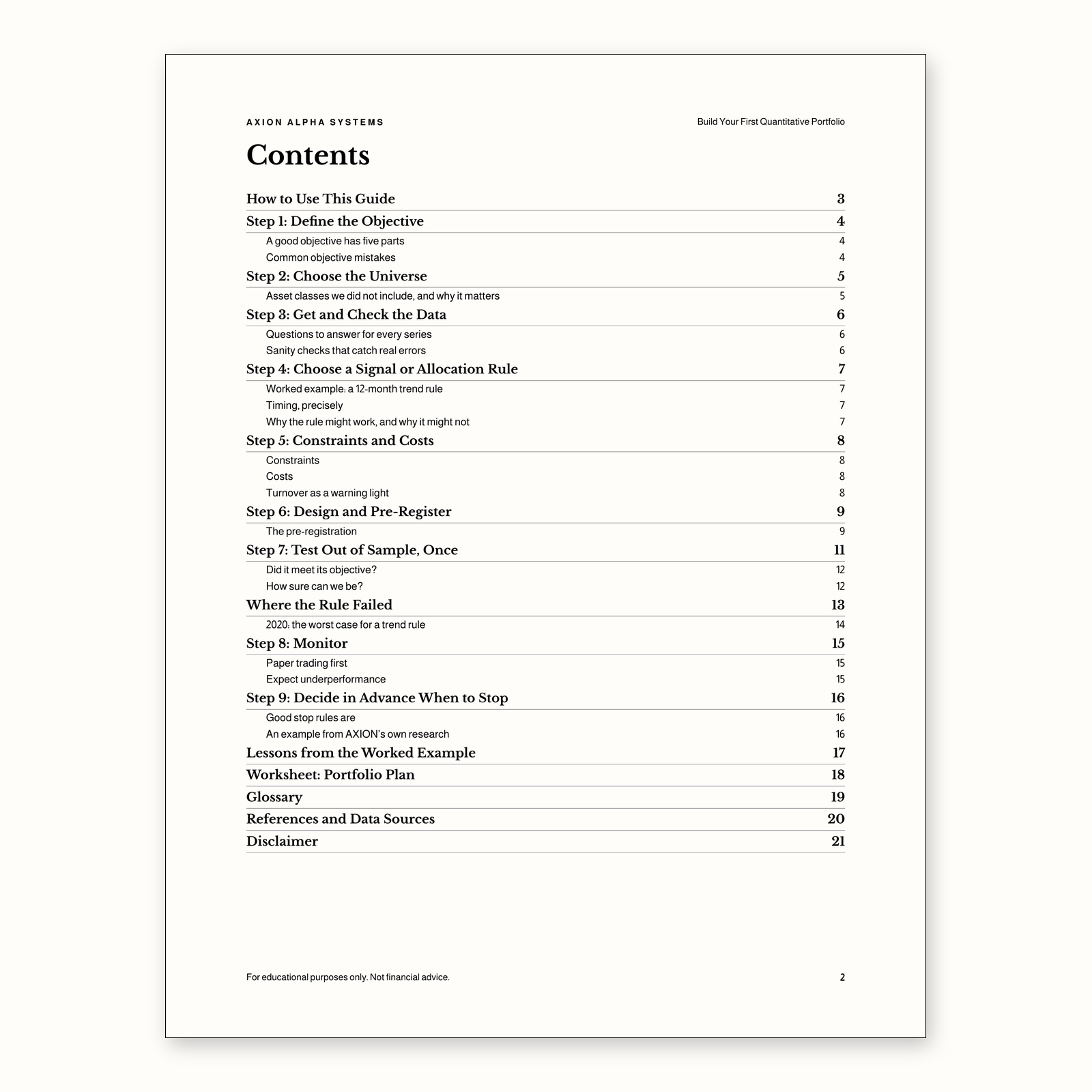 Image 2 of 4
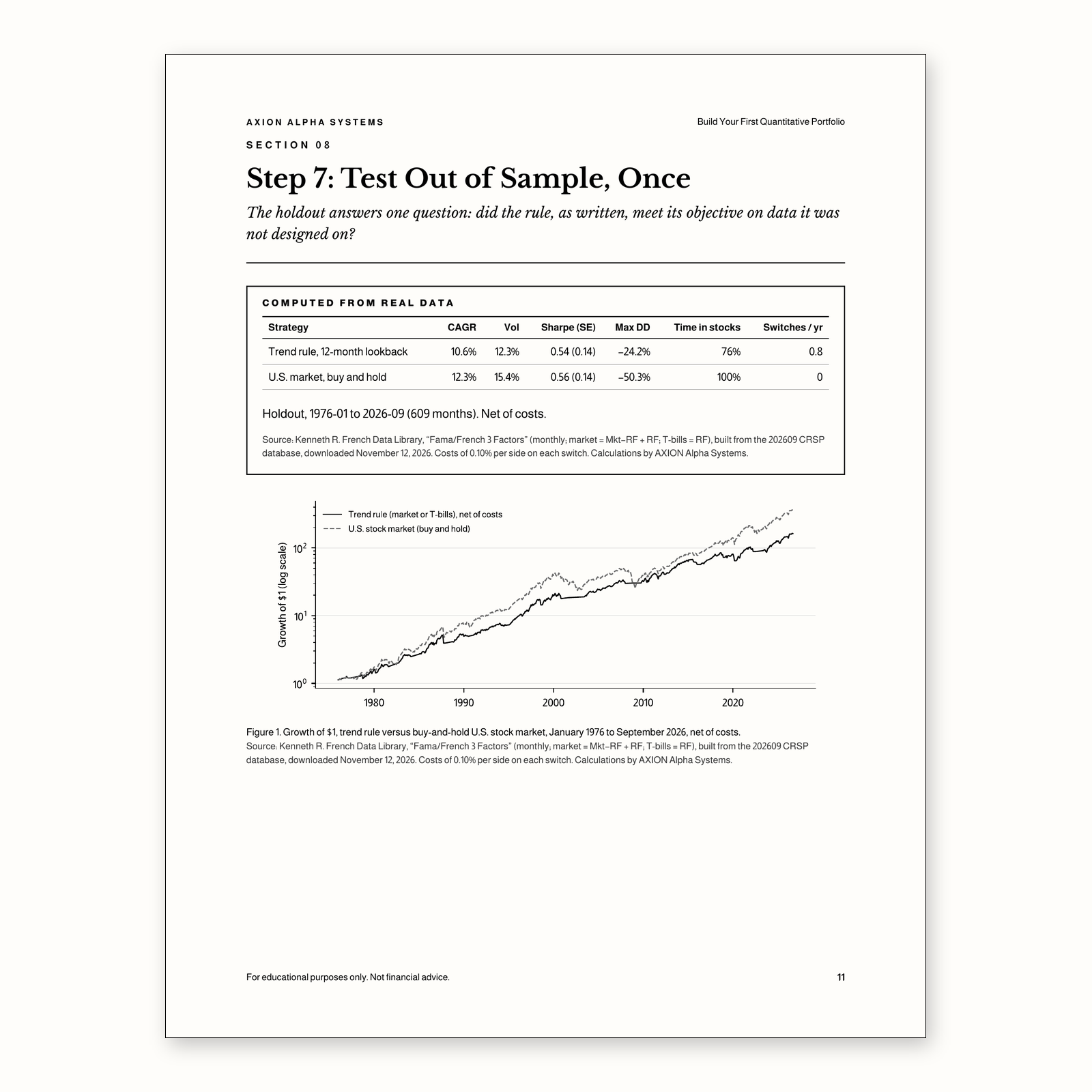 Image 3 of 4
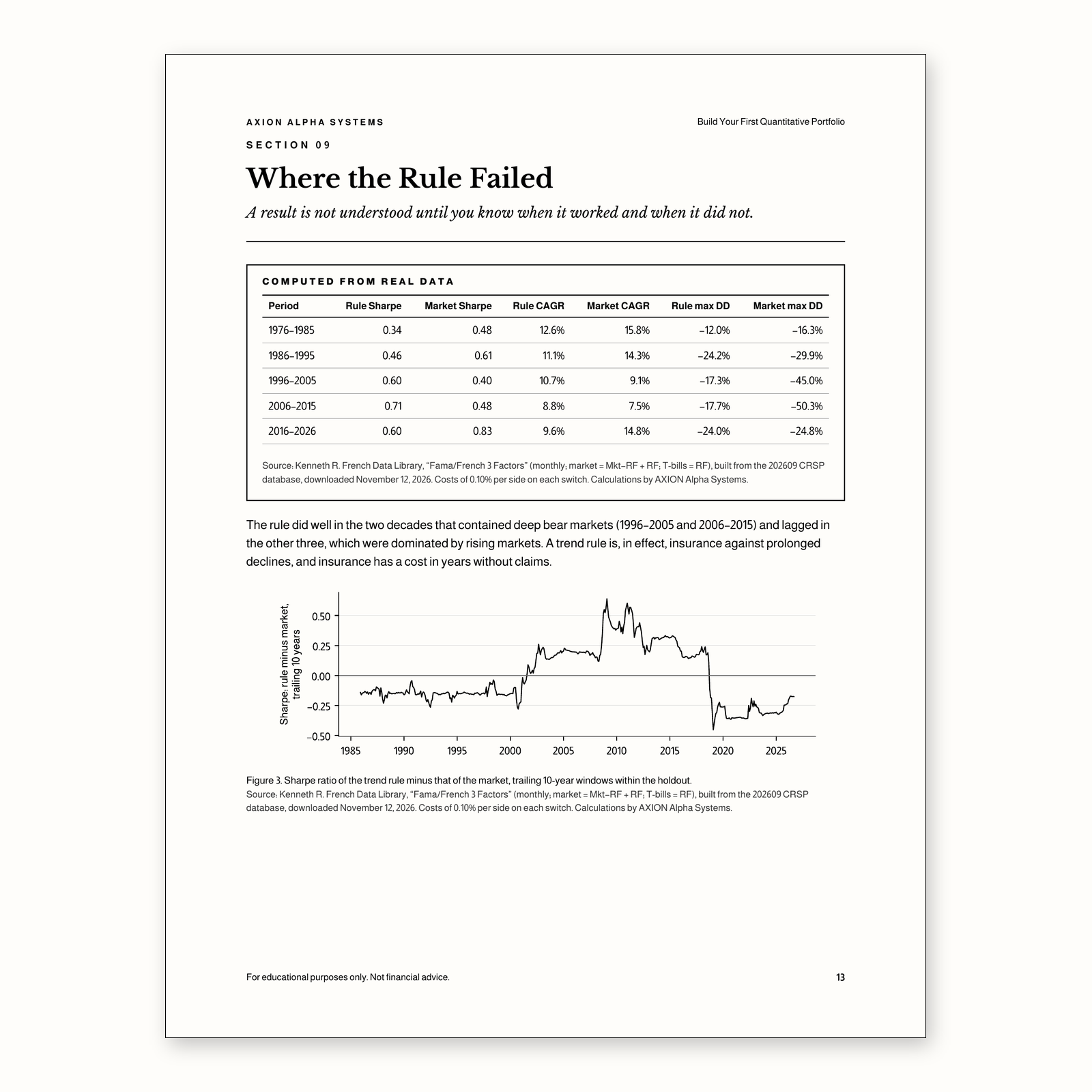 Image 4 of 4
A 21-page step-by-step PDF that takes you from objective to stop rule: universe, data checks, a rule, costs, pre-registration, one out-of-sample test, monitoring, and deciding in advance when to quit. The worked example uses a century of real U.S. data and is reported honestly, including the three of four pre-registered tests it failed.
Step 1–2: writing an objective with five parts, and choosing a universe without hindsight
Step 3: getting data and the sanity checks that catch real errors
Step 4–5: choosing a rule, timing it precisely, and accounting for constraints, costs, and turnover
Step 6: splitting design and holdout periods and writing a pre-registration with pass/fail tests
Step 7: testing once, out of sample, with standard errors
Worked example: a 12-month trend rule on U.S. stocks and T-bills, designed on 1927–1975 and tested on 1976–2026. It cut the worst drawdown from −50.3% to −24.2% but failed three of four pre-registered tests
Where the rule failed, including 2020 and 1987
Steps 8–9: paper trading, monitoring, and stop rules, with an example from AXION’s own research
A portfolio-plan worksheet, glossary, and references
Self-directed investors and students who understand returns and volatility and want a disciplined process for designing and testing a simple rules-based portfolio before risking money on it.
PDF, 21 pages, US Letter. Instant download. Includes a printable worksheet.
It is not investment advice, and the worked example is not a recommended strategy. It failed its own pre-registered standard, and its holdout is not truly unseen because the rule is well known. Historical figures describe the past only.
Does the example strategy work?
Not by its own pre-registered standard. It reduced drawdowns but gave up return and failed three of four tests. The guide shows why, which is the point.
Where does the data come from?
The Kenneth R. French Data Library (U.S. market and one-month T-bills, July 1926 to September 2026), downloaded November 12, 2026.
Do I need to code?
No. The steps can be followed in a spreadsheet. AXION’s Python for Financial Research and Portfolio Risk Analysis Workbook are optional companions.
Is this investment advice?
No. It is for educational purposes only.
For educational purposes only. Not financial advice. This product does not recommend any security, fund, or strategy, and nothing in it is a promise of future returns. Historical figures describe the past only.
A 21-page step-by-step PDF that takes you from objective to stop rule: universe, data checks, a rule, costs, pre-registration, one out-of-sample test, monitoring, and deciding in advance when to quit. The worked example uses a century of real U.S. data and is reported honestly, including the three of four pre-registered tests it failed.
Step 1–2: writing an objective with five parts, and choosing a universe without hindsight
Step 3: getting data and the sanity checks that catch real errors
Step 4–5: choosing a rule, timing it precisely, and accounting for constraints, costs, and turnover
Step 6: splitting design and holdout periods and writing a pre-registration with pass/fail tests
Step 7: testing once, out of sample, with standard errors
Worked example: a 12-month trend rule on U.S. stocks and T-bills, designed on 1927–1975 and tested on 1976–2026. It cut the worst drawdown from −50.3% to −24.2% but failed three of four pre-registered tests
Where the rule failed, including 2020 and 1987
Steps 8–9: paper trading, monitoring, and stop rules, with an example from AXION’s own research
A portfolio-plan worksheet, glossary, and references
Self-directed investors and students who understand returns and volatility and want a disciplined process for designing and testing a simple rules-based portfolio before risking money on it.
PDF, 21 pages, US Letter. Instant download. Includes a printable worksheet.
It is not investment advice, and the worked example is not a recommended strategy. It failed its own pre-registered standard, and its holdout is not truly unseen because the rule is well known. Historical figures describe the past only.
Does the example strategy work?
Not by its own pre-registered standard. It reduced drawdowns but gave up return and failed three of four tests. The guide shows why, which is the point.
Where does the data come from?
The Kenneth R. French Data Library (U.S. market and one-month T-bills, July 1926 to September 2026), downloaded November 12, 2026.
Do I need to code?
No. The steps can be followed in a spreadsheet. AXION’s Python for Financial Research and Portfolio Risk Analysis Workbook are optional companions.
Is this investment advice?
No. It is for educational purposes only.
For educational purposes only. Not financial advice. This product does not recommend any security, fund, or strategy, and nothing in it is a promise of future returns. Historical figures describe the past only.